Why FAANG Are Betting on Causal AI
TL;DR
Microsoft, Meta, Netflix proved causal AI works at scale. Still using correlations? You're making amateur-hour decisions.
When the world's most sophisticated technology companies all invest in the same capability, it's not a coincidence. It's a signal.
In our last post, we showed how Fortune 500 companies like Atlassian, Salesforce, and DoorDash deployed causal AI to drive measurable business impact—12% retention lifts, 13% revenue increases, 72% cost reductions. Real results from production systems.
But there's a parallel story that's equally telling: while enterprises were proving causal AI works in the field, Big Tech was building the infrastructure to make it work at unprecedented scale. Microsoft, Amazon, Meta, Google, Netflix, and Uber aren't just experimenting with causal inference. They're establishing dedicated research groups, publishing foundational papers, building open-source libraries, and embedding causal reasoning into core product systems.
This isn't R\&D theater. This is strategic investment in what these companies believe will be fundamental infrastructure for the next decade of AI. Here's what they're building—and why it matters for every organization thinking about causal AI.
The Big Tech Causal AI Landscape#
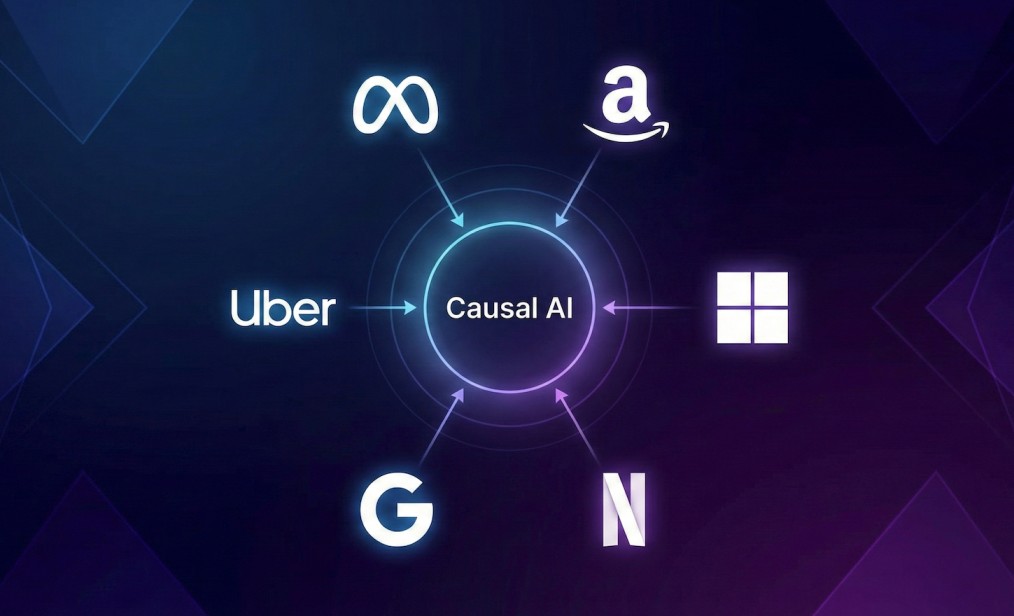
Microsoft: Making Causal Inference Enterprise-Ready#
- What they're building: Microsoft Research operates a dedicated Causal Inference Group that combines machine learning with causal methods for counterfactual reasoning and robust decision-making.
- Where they're applying it: Decision optimization, fairness assessments, model interpretability, and business impact simulations across Microsoft's enterprise products.
- Why it matters: Microsoft isn't building causal AI for research papers. They're building it for Azure customers, Office 365 deployments, and Dynamics business applications. When Microsoft invests in making causality enterprise-ready, they're anticipating that their largest customers will demand these capabilities.
- Learn more: Microsoft Research Causal Inference Group
Amazon: Causal Reasoning for Autonomous Systems#
- What they're building: Amazon Science publishes extensively on causal inference for explanation and decision theory in autonomous systems, including work like "Why Did They Do That?" on causal explanation frameworks.
- Where they're applying it: Decision-making systems, explainable recommendations, supply chain optimization, and experimental design across Amazon's retail and AWS operations.
- Why it matters: Amazon operates at a scale where correlation-based systems break down. When you're making billions of micro-decisions daily—what to recommend, where to position inventory, how to route packages—you need to know what actually causes outcomes, not just what correlates with them.
- Learn more: Amazon Science
Meta: Causal AI in Production at Billion-User Scale#
- What they're building: Meta publishes foundational research on counterfactual reasoning, off-policy evaluation, and causal learning from logged bandit data. They've deployed causal inference directly into production systems.
- Where they're applying it: One public example: Meta used causal inference to optimize push notifications on Instagram, balancing engagement with user experience. The system had to answer: "What would engagement look like if we sent fewer notifications?"—a causal question that correlation can't answer.
- Why it matters: Meta proved causal AI works at the scale of billions of users and trillions of interactions. If causal methods can handle that complexity, they can handle yours.
- Learn more: Meta Research on Counterfactual Reasoning
Google / DeepMind: Causality for Responsible AI#
- What they're building: DeepMind researches Causal Bayesian Networks to formalize and mitigate unfairness in AI systems. Google integrates causal frameworks into fairness assessments, reinforcement learning, and explainable AI.
- Where they're applying it: Model interpretability, fairness in ranking and recommendation systems, and ensuring AI systems make decisions for the right reasons—not just accurate predictions, but causally sound ones.
- Why it matters: As AI systems make increasingly consequential decisions, "it works" isn't enough. Regulators, customers, and internal stakeholders want to know why it works. Causal frameworks provide that explanation in a rigorous, defensible way.
- Learn more: DeepMind Causal Bayesian Networks
Netflix: Production-Scale Causal Inference Systems#
- What they're building: Netflix has built what they call "Computational Causal Inference at Netflix"—production-scale systems for A/B testing, Bayesian modeling, and heterogeneous treatment effects across their entire user base.
- Where they're applying it: Personalization algorithms, recommendation effectiveness measurement, marketing optimization, and content performance analysis. Every major decision about what shows to produce, how to position them, and who to target involves causal inference.
- Why it matters: Netflix published their approach because it works and they want to establish thought leadership in the space. When a company whose entire business model depends on understanding what causes users to watch more content invests this heavily in causal AI, it's a strong signal about where the industry is headed.
- Learn more: Netflix Tech Blog on Causal Inference
Uber: Open-Sourcing Causal ML#
- What they're building: Uber Engineering created and maintains CausalML, an open-source Python library for uplift modeling and causal inference. It's become one of the most widely used tools in the causal AI ecosystem.
- Where they're applying it: Marketing optimization (who should get which promotions), rider-driver matching improvements, and measuring the causal effects of policy changes across Uber's two-sided marketplace.
- Why it matters: Uber didn't just build causal capability for themselves—they open-sourced it because they believe widespread causal AI adoption benefits the entire ecosystem. That's the move of a company that sees causality as foundational infrastructure, not competitive advantage.
- Learn more: Uber Engineering Blog on Causal Inference
Three Patterns Across Big Tech's Causal AI Investments#
Looking across these initiatives, three clear patterns emerge:
1. Causal AI Moves from "Research" to "Infrastructure"#
Five years ago, causal inference was a research topic. Today, it's production
infrastructure. Microsoft has a dedicated group. Netflix built production-scale
systems. Uber open-sourced their toolkit. Meta deployed it to control billions
of notifications.
This is the trajectory of every important technology: research → experimentation
→ production → infrastructure. Causal AI is completing that transition now.
2. Scale Demands Causality#
The companies investing most heavily in causal AI are the ones operating at the
largest scale. When you're making billions of decisions, correlation-based
heuristics fail. You need to know what actually causes outcomes.
This matters for enterprises because the scale at which causality becomes
necessary is getting lower. What required Google-scale resources five years ago
is accessible to mid-market companies today.
3. Explanation Becomes Non-Negotiable#
Google and DeepMind's focus on fairness and interpretability reflects a broader trend: stakeholders—customers, regulators, boards—increasingly demand to know why AI systems make the decisions they do. Causal frameworks provide rigorous answers. Correlation-based models don't. As AI becomes more embedded in consequential decisions, that distinction will determine which systems get deployed and which get shut down.
What This Means for Causify.AI (and Our Customers)#
At Causify.AI, we're watching these Big Tech investments closely—not as competitors, but as validators. When Microsoft builds causal inference infrastructure, they're confirming what we've built our company around: causality is becoming fundamental to enterprise AI. When Netflix publishes their production causal systems, they're proving that causal methods work at scale—which means they'll work for organizations orders of magnitude smaller. When Uber open-sources CausalML, they're expanding the ecosystem of tools, talent, and knowledge that makes causal AI more accessible to everyone. This is good for Causify.AI because we're not trying to convince the market that causal AI matters. Big Tech already did that. We're helping enterprises deploy it faster, more reliably, and with less technical risk than building from scratch. Our platform leverages the best of what companies like Netflix and Uber have proven works, while abstracting away the complexity that requires teams of PhD researchers. We're making causal AI accessible to organizations that don't have Microsoft Research budgets or Netflix engineering resources.
What This Means for Your Organization#
If you're a data science leader, Chief Analytics Officer, or enterprise decision-maker, here's what Big Tech's causal AI investments should tell you: First, the technical risk is gone. When Microsoft, Amazon, Meta, Google, Netflix, and Uber all bet on the same technology stack, it's not experimental anymore. Causal AI works. The question is implementation, not viability. Second, the competitive window is closing. Big Tech already has causal capability in production. Forward-thinking enterprises like Atlassian, Salesforce, and DoorDash are deploying it now. The organizations that wait will find themselves competing against companies making fundamentally better decisions. Third, build vs. buy calculus has shifted. Five years ago, you had to build causal AI capability from scratch—there weren't mature platforms. Today, you can deploy production-ready systems in months, not years. The ROI case for buying rather than building is stronger than ever. Fourth, talent expectations are changing. As causal AI becomes standard infrastructure, data scientists will expect to work with these tools. The best talent will gravitate toward organizations that provide modern causal capabilities, not legacy correlation-based stacks.
The Market Is Telling You Something#
When both Big Tech and Fortune 500 enterprises independently converge on the same technology, pay attention. Big Tech is investing because they've seen causal AI solve problems that correlation-based methods can't. Enterprises are deploying it because they're seeing measurable ROI. Open-source communities are growing because practitioners recognize this is the future of decision science. At Causify.AI, we're in the business of accelerating that transition. We've built what enterprises need to deploy causal AI at scale: robust causal discovery, heterogeneous treatment effect estimation, integration with existing data stacks, and interpretability that business stakeholders can actually use. The theory is proven. The tools exist. Big Tech validated the approach. Fortune 500s proved the ROI. The question isn't whether to adopt causal AI. The question is whether you'll lead or follow.
Ready to bring causal AI to your organization? Schedule a demo to see how Causify.AI makes enterprise-scale causal inference accessible, or contact our team to discuss your specific use case.