Causal ELI5: Ladder of Causality
TL;DR
Your AI can predict everything but understands nothing without climbing the causality ladder.
Judea Pearl's Ladder of Causality has three levels: association (observing correlations), intervention (predicting effects of actions), and counterfactuals (imagining alternate outcomes). It's important because it shows that true causal understanding goes beyond data patterns, enabling reasoning about change and "what if" scenarios—essential for science, decision-making, and artificial intelligence.
Ladder of Causation#
The ladder of causation is a way to describe how humans and machines understand cause and effect, created by Judea Pearl.
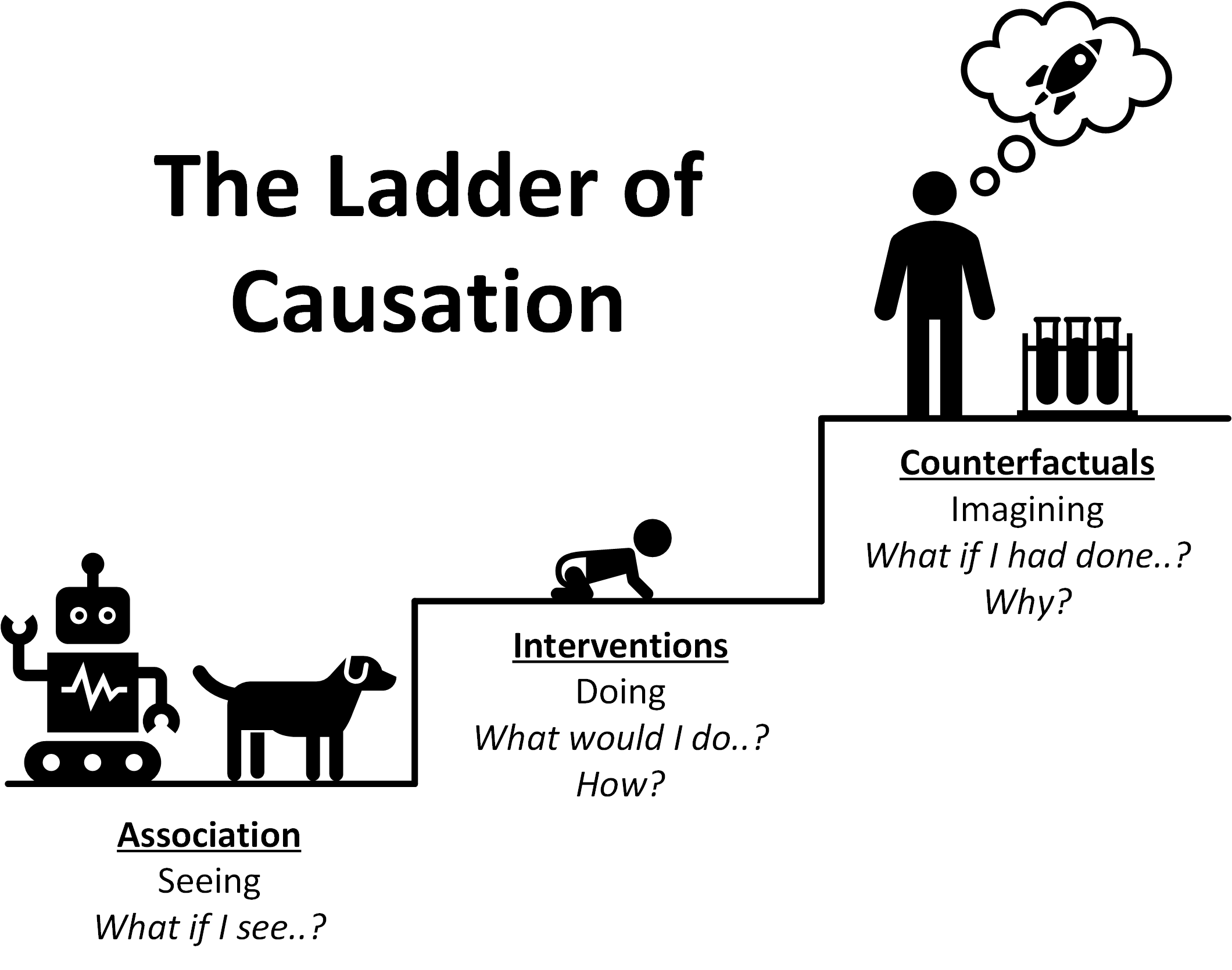
It has three rungs (levels), each representing a deeper kind of reasoning.
1. Association (Seeing)#
You're just seeing relationships, not asking why they happen.
- Question: What goes with what?
- Example: "When it rains, people carry umbrellas."
- What we do: We notice patterns and correlations.
- Tools: Traditional tools (e.g., statistics, machine learning, observations)
2. Intervention (Doing)#
You're doing something and seeing how it affects the world.
- Question: What happens if I change something?
- Example: "If I make it rain (turn on a rain machine), will people carry umbrellas?"
- What we do: We perform experiments or imagine actions.
- Tools: Randomized trials, do-calculus.
3. Counterfactual (Imagining)#
You're imagining alternate worlds to understand deeper causes.
- Question: What would have happened if things were different?
- Example: "If it hadn't rained, would people still have carried umbrellas?"
- What we do: We imagine alternate realities, what could have happened but didn't.
- Tools: Causal models, counterfactual reasoning.
Summary Table#
| Level | Name | Key Question | Example | Tool |
|---|---|---|---|---|
| 1 | Association | What goes with what? | Rain -> Umbrellas | Statistics |
| 2 | Intervention | What if I do something? | Make rain -> More umbrellas | Experiments |
| 3 | Counterfactual | What if things were different? | If no rain -> No umbrellas? | Causal models |
The ladder of causation is important because it shows how our understanding of the world, and our ability to make decisions, depends on more than just data.
1. Why is it Important#
- Most AI systems and statistics live on the first rung of association
- They can tell us what is related to what, but not why or what would happen if we changed something.
- Example: A model might predict that people buy ice cream when it's hot, but it can't tell you if making it hot would make more people buy ice cream.
With only association and without causation, we can't confidently make decisions or policies.
2. It helps us design better experiments#
- On the second rung (intervention), we move from just watching to doing.
- We ask: "What happens if I change this?"
- This is what scientists and policymakers do when they run randomized controlled trials (RCTs), they test causes directly, not just observe patterns.
Without this step, we might mistake correlation for causation (like thinking ice cream causes sunburns).
3. It Lets Us Imagine Alternate Realities#
- The third rung (counterfactual) is how humans reason about responsibility, fairness, and prediction.
- We ask: "What would have happened if things were different?"
- Example: "Would this patient have survived if they'd gotten the new treatment?"
This is key for:
- Ethics and law (Was someone's action the cause?)
- Medicine (Would another treatment work better?)
- AI safety (What would have happened if the system made a different decision?)
4. It Guides How We Build Smarter AI#
- Modern AI systems mostly learn from data (association).
-
To truly understand the world, AI needs to climb the ladder, to reason about interventions and counterfactuals, like humans do.
-
That's how AI can go from predicting what happens, to understanding why it happens, and even imagining what could have happened instead.
The ladder of causation matters because it's the foundation of true understanding, reasoning, and decision-making, for both humans and machines.